My Blog List

Apr 18, 2020

Spinning Fairy Tales Anew (Spinning Silver book review)

Spinning Silver by Naomi Novik

I wanted to speak to the references to Rumpelstiltskin in this book. Even the title itself, Spinning Silver, is a play on the original tale, but this time Novik chooses to have the characters spinning silver instead of straw.
I got into this book and my mind immediately thought of two old tales to compare to our assigned book. The first was the ancient Greek tale of Midas who everything he touched turned to gold. This made sense with Miryam being able to turn both her wares and coins into gold, and was only reaffirmed when she could literally turn the crown and coins to gold with her touch. But as I read on, I quickly decided that it was based more on the second of my thoughts, Rumpelstiltskin.
There are many versions of the tale of Rumpelstiltskin, but the most well known of them is by The Brothers Grimm. In many versions, the common details that appear are: a girl from a poor family (general a millers daughter) and a wealthy man wedding her because of a lie someone told about her accomplishing great feats (generally spinning straw or skeins). Then the imp or demon aiding her  and the repetition of the number three (three times she must sew gold, three times she tries to guess the creatures name), and then the creature (Rumpelstiltskin) gloating and revealing his name so he loses his bargain. The Brother Grimm version can be found here if you want to read it, it is very short: https://www.pookpress.co.uk/rumpelstiltskin-brothers-grimm/
This plays in greatly to the importance of deals within the book, because the point of the story is the girl accomplishing a deal their parents made or else they are killed, then making deals with Rumpelstiltskin himself and eventually getting out of them. This could be why the Staryk king is so firm about no debts. It also explains why Miryam and Irina make deals in many different forms because the heroine in the original tale is forced into one deal for marriage vs death, then the next giving away her belongings and children vs no gold, and then finally names vs her child. The girls are all different forms of the heroine from the story in my mind, all different parts of her time. Wanda being the millers girl who is hungry and eats pies from the version of the story called Tim Tit Tom, Irina being the girl forced into a marriage she didn’t ask for, and Miryam trying to not lose what she holds dear (her self respect etc).
But I wouldn’t categorize this book as a retelling of the story of Rumpelstiltskin. Some books I’ve read would be, such as ones that take off from where the fairytale left off like in Just Ella by Margaret Peterson Haddix. Others keep the main elements of the tale but put it in a new context, such as changing the culture of the story etc. But this book doesn’t do that. We get the millers daughter in Wanda, but she is not the one who can turn things to gold. We get the deal with the imp aka the Staryk king, but instead of the heroine getting out of the deal by learning his name to keep her firstborn child, the Staryk king himself is the one trying to protect those he cares about by nobly trying to keep his people from melting.
The book is a wonderful version of what I ideally would like to accomplish with my work. References to classic folktales and myths without being predictable recreations.
A must read.

Feb 12, 2020

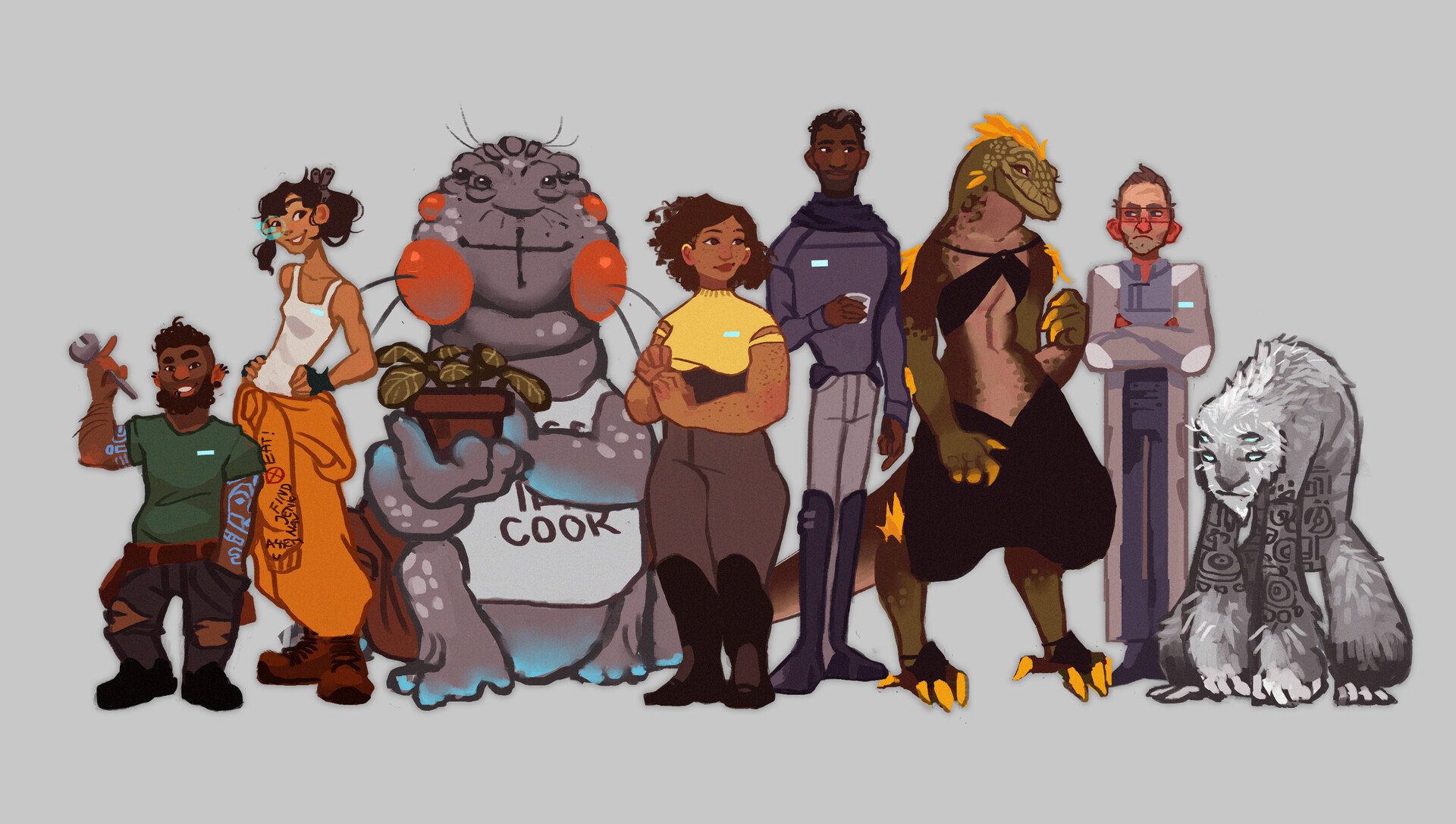
A Long Book Not Really About A Planet (A Long Way to a Small Angry Planet book review)

 Image result for a long way to a small angry planet characters


A Long Way to a Small Angry Planet by Becky Chambers

Before I get into my analysis of this book, let me just share my favorite quote, told by Sissix to Ashby: “Come on. Put on your trousers. I want to meet the woman who gets to take them off.”

This book is definitely geared more toward social issues than it is toward plot. However, that really works for the book, and I found myself enjoying all of the species diversity, character interactions, government commentary, and environmental issues.

This book definitely touches on multiple social issues we face in our current society. It speaks to racism and how other species are not only treated, but how they are spoken about. Like how initially Rosemary described Sissix not as beautiful in human standard, but as striking. She can’t judge that the Aandrisk appearances by human norms. That also is seen in how Sissix at the beginning sensors her affection with Rosemary despite Rosemary expecting overt affection from her studies of Aandrisks. They can’t always believe what word of mouth or books teach them about society and morality of others without personal experience. Not only that, but the book touches on language barriers and how different people adapt in order to be able to communicate or interact with other species, like how Ashby knows the basics of Pei’s color language and how she has a vocal implant to be able to speak aloud to him.

The book not only speaks to racial outcasts though, it also speaks to gender and sexuality, and even to mental health. For example, the ‘rashek’ Aandrisk that Sissix sees on the street is very similar to modern day perceptions of Autism. Without the prompt asking this though, I would have just categorized the action with any other form of social isolation to things people see as odd, like how westerners view eating bugs as gross whereas other cultures don’t. But with the prompt, I thought about it more in regards to even people of her own species treating her differently and the answer became clear. She isn’t physical contagious with a disease, she just is ‘awkward’ and doesn’t know how to properly interact with other people around her. Sissix gives her affection while other Aandrisks who are from there walk by and act as if they don’t see the older woman.

A Long Way to a Small Angry Planet made me think back to the social issues addressed in The Bear and the Nightingale as well. That book talked about cultures changing and evolving, like Christianity taking over primarily pagan spaces, or the social expectations of a young girl growing up in that time period and era. This book felt like it also focused on topics like that in regards to outside influences and perspectives views on other societies. Rosemary was a newcomer, someone who had never left her home planet of Mars, and yet she was very accepting in trying to be respectful and not judgmental of all these species lives and customs she wasn’t used to. She even was reasonable with the space pirates, who were a great representation of the lower economic class turning to crime in order to take care of their family.

There are too many social issues to get into in so little space. I haven’t even touched on how society views death, and the perspective of Ohan and the other crew on their dying. Needless to say, this book is much more about the characters and their interactions than about plot. I thought the book was slow until 1/3 of the way through when the crew got a new job for tunneling. But as I got farther into the book, my perspective changed too. I went into the book with expectations of tension and stakes in plot to keep me reading, like I do with most stories, but this book changed my mind. While it is a lot of world building and background information following several characters, it works. When I restructure my framework of what I expect out of a book and take a step back, I really enjoyed the book. It flowed well and I was interested in every single character's goals and motivations.

Verdict: a must-read.

Feb 1, 2020

Books I Read in 2020


The Bear and the Nightingale (Katherine Arden) 312 pgs
A Long Way to a Small Angry Planet (Becky Chambers) 438 pgs
Annihilation (Jeff VanderMeer) 208 pgs
The City of Brass (S. A. Chakraborty) 569 pgs
The Calculating Stars (Mary Robinette Kowal) 424 pgs
Spinning Silver (Naomi Novik) 480 pgs
The Haunting of Hill House (Shirley Jackson) 246 pgs
Hell House (Richard Matheson) 304 pgs
Ghost Story (Peter Straub) 567 pgs
Nightmare House (Douglas Clegg) 340 pg
The Amityville Horror (Jay Anson) 256 pg
Grave's End: A True Ghost Story (Elaine Mercado) 192 pg

Jan 29, 2020

Class Book Overview: Recent Sci-Fi/Fantasy (4/18/20)


Related image

Do Read:

***** Spinning Silver (Naomi Novik)
**** A Long Way to a Small Angry Planet (Becky Chambers)
**** The Bear and the Nightingale (Katherine Arden)
*** The City of Brass (S.A. Chakrabartz)


Don't Read:

** Annihilation (Jeff VanderMeer)
** The Calculating Stars (Mary Robinette Kowal)

Christians vs Pagans: The Book (The Bear and the Nightingale book review)

The Bear and The Nightingale by Katherine Arden

Image result for winter warlockImage result for winter warlock


Prompt: The folklore- Arden makes fantastic (pun intended) use of the folklore of her chosen era, all the chyerti of the old religion. To mention just a few:  the vodianoy or river-king, the domovoi that cleans and mends and lives in the oven, the twig-man in the trees, the rusalka with her green skin and weedy hair, the vazila who looks after horses, the bannickor bath-house spirit, the leshiye or wood-guards who lead people astray, the upyr or the undead (from where we get the name “vampire”). How has the author used this rich storehouse of known folklore to produce her novel, to generate its plot, its conflicts, its characterization.

Before I even started the book, the use of folklore to generate the books plot was evident in the blurb. But even before the first page, it tells of how not honoring the household spirits creates conflict in the story and it is up to Vasya to save everything. The characters are mythological creatures, the plot is about them and the girl who can see them, the conflict is caused by their kind. Everything is looped into this retelling of folklore that not many people know much about.

I knew the rusalka before this book, having researched it and other sirens/mermaids for my thesis before I had chosen on a firm setting for my story. I adored seeing it and other odd folk creatures pop up in this story. I think that folklore and myths outside of Greek, Roman, and Norse are not mentioned enough, so it’s nice to see them utilized and brought to the publics attention.

We think of mythological creatures having existed for years before us and being self-aware, so I love that some of them in this book, like the vazila doesn’t know how it came to be and ‘names itself’. I also appreciate that this girl who is one of the few that can see the spirits befriends even he dangerous ones, like the rusalka, and in exchange for her companionship they all seem to teach her a special skill of nature beyond what other humans normally know, like speaking the language of horses or climbing trees like cats. The most obvious use of the lore though is the frost demon, who makes appearances throughout the story. I love retellings, like how Morozko is another version of Father Frost/ Jack Frost. It brought up fond memories of movies where winter is depicted as both harsh and festive, like the Winter Warlock from Santa Claus is Comin’ To Town.

However, the pacing of the book feels like the author decided to include Vasya’s entire life and backstory chronologically rather than only including the important parts and sprinkling in past details throughout as necessary. It reads like something you would read a chapter or two of before bed each night, but would be unable to binge read. That is, at least not until about 100 pages in.

The evidence is clear when you consider the blurb versus the content of the book. The blurb tells us right away that Vasya’s mother dies and the girl has issues with her new stepmother, but we don’t even get her step-mother’s marriage until Chapter 9. Plus, for a book supposedly about Vasya, all the chapters up until 11 are more a tale of Pyotr and the struggles of being a single dad with tons of children. All of Part 1 is interesting, but disjointed from the mood of the other sections. The plot really gets going once we reach Part 2.

That being said, I really enjoyed the book after that. I can see why it get glowing reviews for it's stunning prose. It is the first book in a trilogy, so I may just have to pick up the other books next time I have free time to read for fun.

Verdict: read at your own pace and savor it

Dec 8, 2019

IT'S THE FINAL COUNTDOWN (course catalog final review)

My final ratings for the assigned content from 'Reading in Genres: Monsters'

Image result for cute cthulhu"

Do Watch:

***** Alien (1979)
****  The Thing (1982)
***    The Blob (1988)
***    Night of the Living Dead (1968)

Do Read:

***** The Call of Cthulhu (H.P. Lovecraft)
**** Snow (Ronald Malfi)
***  The Funeral (Richard Matheson)
*** Breeding Ground (Sarah Pinborough)
*** The Outsider (H.P. Lovecraft) 
*** Relic (Douglas Preston & Lincoln Child)
**   Pickman's Model (H.P. Lovecraft)
**   World War Z (Max Brooks)
**  The Yattering and Jack (Clive Barker)

Don't Watch:

**      Godzilla (2014)
**     An American Werewolf in London (1981)

Don't Read:

**    Rawhead Rex (Clive Barker)
**    30 Days of Night (Steve Niles)
**    Cycle of the Werewolf (Stephen King)
*      I Am Legend (Richard Matheson)

And DO READ the craft book Writers Workshop of Horror (Michal Knost) whether you write horror or not!

How Many Days of Night Were There? (30 Days of Night graphic novel review)


I had a very hard time figuring out what the monsters were in 30 Days of Night by Steve Niles. I assumed they something like the hybrid zombie vampires in I Am Legend, especially because the zombies in I Am Legend couldn’t withstand being out in sunlight. But everyone else who has read this seems to definitively define them as vampires. I realize that is what they are now after Googling the book, but I was very confused. Instead of a set of fangs, they has circular jagged teeth like a leach, and they clearly call them undead. Yes, vampire are also a kind of undead, but in general that specific term is used to define zombies. It was unclear to me, but since they drink blood, I suppose vampire was the right answer. The art style didn’t make my confusion any better.

I like visual novels. I read Webtoons and online comics all the time. I’ve liked the visual novels we’ve read in this class so far. Until now. The art style in this novel was so messy and blurry. Maybe the story would have been better in the text form versus the comic, or maybe the movie makes it better, but I found myself unsure what some of the panels were depicting. While this helped create a very distinct aesthetic and showed off the mood of the comic through the frazzled style, I really hated it. It was distracting and made the story much harder to digest than it needed to be. I don’t want to have to question whether a scene is blood or not because of how sketchy the image alongside the text is.

I will say that the plot pacing of the comic was good though. It all flowed nicely together, and was very quick in the parts that weren’t slowed down by the artwork. Though I knew from the setup that the novel was 30 days of night with no sunlight, I also would have believed you if you told me the novel was only one long evening. I think that is both a pro and a con to this story. It means the flow was very smooth, but it also kind of made it difficult for me to rate the stakes of the story. They kept talking about the hidden humans being hungry, but I didn’t see that in the pacing. I wish the time had been more exaggerated in the comic. I didn’t feel the suspense build.

As for the actual vampires themselves, I loved that we assumed the original guy killing everyone was the big bad, then Vicente arrives and they assume he’ll be pleased, only for him to wreck shop with distaste. I love the idea of creatures exploiting their being myths and fairy tales. I thought that part of the story was the most clever. However, I didn’t really understand the guy coming in with the helicopter. I’m sure it was more vital in text or movie form, but it felt out of place in the graphic novel version and unnecessary. I also thought the ending was a cop out. The sheriff turns and is somehow able to control himself when the other infected guy wasn’t able to, and then after he wins the fight he just drifts off into dust and doesn’t bite his wife. Anticlimactic to say the least.

Not the worst story we’ve read in this class, but definitely the worst graphic novel assigned.

Dec 5, 2019

Is Relic a Relic of the Past? (Relic book review)


Relic by Douglas Preston and Lincoln Child was a good book. Not a great book, not a bad book, a good book, but I will say that it was one of the easiest books this term to sit down and binge read. It definitely read like an old school horror movie. It felt like going to the cinema to watch some black and white monster movie.

The novel is written very well, flowing together very nicely. The chapters read quickly, and it’s also easy to read because of how much it feels like a classic murder mystery, like Agatha Christy but supernatural. It reminded me of the YA fiction I consumed feverishly as a teen, where I could sit down and binge the book in a few hours. And that’s exactly what I did with this book. That being said, the story did drag on a little for me though.

The book didn’t really get going for me until around Chapter 40, when the museum party started. But to be fair, most of the students so far that have posted reviews of the book have said that the plot got good after hitting the halfway point, and that’s for a reason. The second half makes it worth a read. Not only that, but the ending to the book was a wonderful twist. I knew it would be a monster because of our reading course being on monsters, but I wouldn’t have guess that the monster was Whittlesey. And I love that I didn’t guess that. Most murder mysteries are easy to guess the ending of, and this one made sure to throw enough twists and turns to keep you guessing until the very end. And then even after the ‘end’, when Kawakita turns out to be sketchy.

However, on a less positive note, I’m going to say it: there are too many characters in this book. I don’t mind having so many specifically main characters, because it is easy to follow them all considering that they are all classical stereotypes, but the main characters plus side characters being referenced by name frequently was a little too much for me to coherently remember.

Also, as everyone seemed to point out, Margo drove me insane with her constant mentioning of her dissertation. I feel like that happened with a lot of the characters, the authors adding a ton of detail to define and introduce them. Then, once introduced, those characters referenced the same things over and over, like Smithback and his book. Once you hit hallway and the plot got going though, those characters became interesting again. For some reason, the many characters bothered me, but the many theories about what was going on didn’t. Nicely done on the murder theories Preston and Child.

After I finished this book, I ended up Googling the monster to see if what I imagined was what the movie depicted for the creature (I also didn’t even know there was a movie until I read someone else’s post). The movie monster was not what I had thought. However, I think I almost like it better than what I had imagined.

Overall: Worth a skim, then an actual read at Chapter 40.

Nov 28, 2019

The Great American Melting Pot... of Bodies (The Blob 1988 movie review)


I watch The Blob (1988) with my boyfriend for date night, and although I haven't seen Twin Peaks myself, he said the mood of this movie was a very reminiscent of that show. He had also watched The Thing with me, and I liked that movie better, while he likes this one, The Blob,  better. 

I found a lot of elements from this movie very funny. From the condom gags when the Reverend showed up, to the yo-yo dangling down while the theater guy is being eaten, to Flagg flipping off the scientists as he jumps over the broken bridge, this movie had me giggling every few minutes. They did a great job pairing their humor with their horror.

Honestly, the monster initially looked like tapioca pudding on the one guy's hand, then grew to looking like the underside of someone's tongue, and ended the movie looking like a giant piece of chewed gum. I can't fault the special effects because this movie was made in 1988, and I did like the fact that the monsters appearance evolved throughout the movie. I'd be interested to see what they could do with the effects given how much I enjoy to them in the movie. Is there a modern remake of this movie? It might be worth a Google.

As far as character deaths went: I loved seeing Paul dissolve in his arm gets severed. Vicki's death was a little more comical with how her face melted inward, and Franny's death and melting face were also great. Honestly, all of the melting visuals were actually wonderful, especially the half dissolved faces scenes, like the theater guy and the lady on the floor that Mega turns over at the movies. The most satisfying death though was the car scene, where the guy who got his date drunk to take advantage of her gets his just desserts. I cheered when he died. I wish his death was even more drawn out honestly, or we got to see him get melted away rather than it being obscured by the car.

After finishing the movie, I'm left with a lot of questions about the content. I wonder why the blob is able to climb through vents and places without dissolving them given its acidic nature, and wonder if it's able to turn that effect on and off. The movie ended with me having many, many questions about the crystals that the monster shatters into. I also was a little skeptical that the blob’s weakness was cold temperatures given that it was born and raised in the cold vacuum of space.

However, I did like that that weakness was alluded to earlier in the movie, along with the usefulness and ‘we’ll get snow’ coming back around full-circle with the snow maker car saving the day. Like in the Writers Workshop of Horrors chapter we read this week on grand finales, the final scene of this movie is left open ended, a cliffhanger set up perfectly for a sequel. Honestly, I think the ending fits quite well (thought I don't remember who that Reverend is vs Meg’s dad). I’ve had more satisfying endings, and I kind of wish it had ended after they beat the blob in town, but it was alluded to earlier in the movie that the Reverend collected some of the crystals in the jar, so at least it was foreshadowed.

Overall, the movie was good, but not the best one we’ve watched so far this term.

Nov 22, 2019

I Lovecraft This Author


I forgot how Gothic and Victorian H. P. Lovecraft reads. I feel like I need to put on a cloak and read these stories by candlelight (which I casually do have the supplies for). However, I only set the scene before reading for Call of Cthulhu.

Related image

Lovecraft set a standard in horror and just fiction in general. Otherworldly horrors became something that still inspires people to this day. I first found my love for him after reading Dagon, and I’ve been delving into spookier reading and writing ever since. I own the Call of Cthulhu tabletop gaming rule books, and even have the Cthulhu Virtual Pet app on my phone. Lovecraft was, and will always be, very influential to writers.

Being objective however, I find the distinct voice Lovecraft has in his writing works really well for his otherworldly Horrorterror stories about gods, but works less for his human stories with a monstrous twist at the end. Both Pickman's Model and The Outsider followed that trope, the twist at the very end, which is kind of predictable by today's standards. I expected both outcomes given the foreshadowing in the text and knowing how Lovecraft writes. That trope is something we see all the time in modern stories. However, I found that it worked much better in The Outsider than in Pickman's Model, where it was a little too drawn out.

My general thoughts on the three stories we read were as follows:

The Outsider was good, albeit predictable. I knew he was going to be the monster in the mirror as soon as he entered the room, but at the same time I liked that twist and was pleased with the ending. The beginning was full of beautiful descriptions very stereotypical to how I would describe the tone to Lovecraft’s writing. Very eloquent.

Pickman’s Model still has the nice descriptions stereotypical of the author, but I felt in this one the lead up was dragging on to get to the point of him describing seeing the pictures at the end. The beginning was saved a little in how he told the story through the narrator’s point of view and interview-style. However, I find myself after the fact remembering very little of the beginning because it all blurred together. Once again, the twist at the end was predictable but acceptable and nice enough.

Call of Cthulhu is a beloved story close to my heart. I’ve read it many times, so I am a little biased rereading it. But at the same time, it is a Lovecraft classic. It has his classic voice and plot arcs that saves explanations until the end. Despite being longer than the other stories above, every part felt necessary and interesting with good foreshadowing. As alluded to in my beginning, instead of reading this story, I listened to it narrated by a British man while I was soaking in a bath and that made it even more aesthetic. It was a glorious experience.

If you think that you’d get to the end and I wouldn’t recommend Lovecraft then you don’t know me very well. I have a purse with Cthulhu on it that I brought with me to my friend wedding. Cthulhu was literally my date to that wedding.

READ H.P. LOVECRAFT.